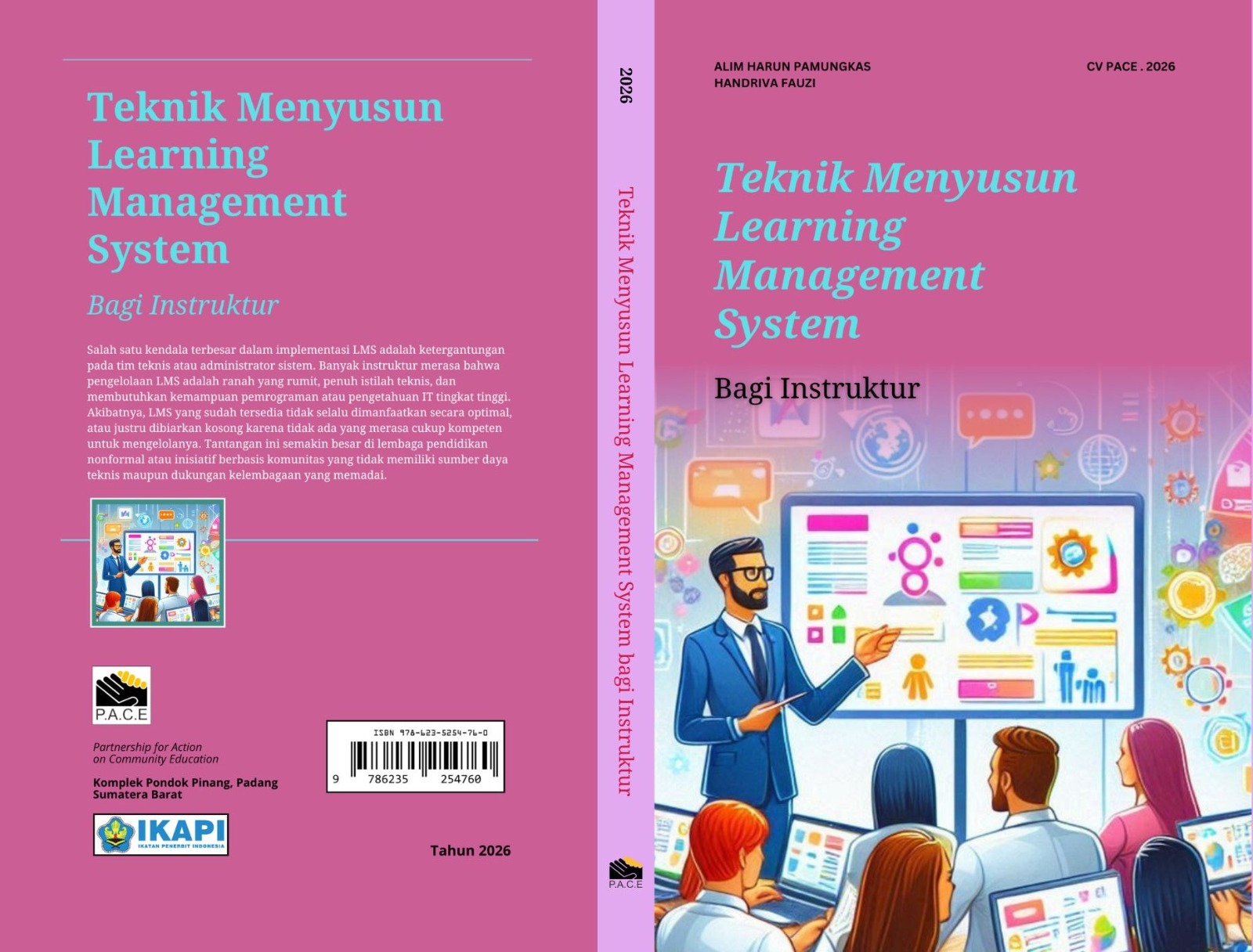
Teknik Menyusun Learning Management System Bagi Instruktur
Abstract
Sinopsis:
Salah satu kendala terbesar dalam implementasi LMS adalah ketergantungan pada tim teknis atau administrator sistem. Banyak instruktur merasa bahwa pengelolaan LMS adalah ranah yang rumit, penuh istilah teknis, dan membutuhkan kemampuan pemrograman atau pengetahuan IT tingkat tinggi. Akibatnya, LMS yang sudah tersedia tidak selalu dimanfaatkan secara optimal, atau justru dibiarkan kosong karena tidak ada yang merasa cukup kompeten untuk mengelolanya. Tantangan ini semakin besar di lembaga pendidikan nonformal atau inisiatif berbasis komunitas yang tidak memiliki sumber daya teknis maupun dukungan kelembagaan yang memadai.
ISBN: 978-623-5254-76-0
References
Ally, M. (Ed.). (2009). Mobile learning: Transforming the delivery of education and training. Athabasca University Press.
Anderson, T., & Dron, J. (2011). Three generations of distance education pedagogy. The International Review of Research in Open and Distributed Learning, 12(3), 80–97.
Arslan, R. S., & Şahin-Kızıl, A. (2010). How can the use of blogs enhance learning in EFL classes? Procedia - Social and Behavioral Sciences, 2(2), 183–187.
Bates, T. (2015). Teaching in a digital age: Guidelines for designing teaching and learning. Tony Bates Associates.
Brookfield, S. D. (1986). Understanding and facilitating adult learning. Open University Press.
Brookfield, S. D. (2015). The skillful teacher: On technique, trust, and responsiveness in the classroom (3rd ed.). Jossey-Bass.
Carr-Chellman, A. (2016). Instructional design for teachers: Improving classroom practice. Routledge.
Clark, R. C., & Mayer, R. E. (2016). E-learning and the science of instruction: Proven guidelines for consumers and designers of multimedia learning (4th ed.). Wiley.
Freire, P. (1970). Pedagogy of the oppressed. Continuum.
Freire, P. (1998). Pedagogy of freedom: Ethics, democracy, and civic courage. Rowman & Littlefield.
Garrison, D. R., & Anderson, T. (2003). E-learning in the 21st century: A framework for research and practice. Routledge.
Horton, M., & Freire, P. (1990). We make the road by walking: Conversations on education and social change. Temple University Press.
Illich, I. (1971). Deschooling society. Harper & Row.
Kirkpatrick, D. L., & Kirkpatrick, J. D. (2006). Evaluating training programs: The four levels (3rd ed.). BerrettKoehler.
Knowles, M. S. (1980). The modern practice of adult education: From pedagogy to andragogy. Cambridge Books. Knowles, M. S., Holton, E. F., & Swanson, R. (2015). The adult learner: The definitive classic in adult education and human resource development (8th ed.). Routledge.
Kolb, D. A. (1984). Experiential learning: Experience as the source of learning and development. Prentice-Hall.
Published
How to Cite
Issue
Section
License
Copyright (c) 2026 Alim Harun Pamungkas, Handriva Fauzi

This work is licensed under a Creative Commons Attribution-NonCommercial-ShareAlike 4.0 International License.
CC Attribution-NonCommercial-ShareAlike 4.0